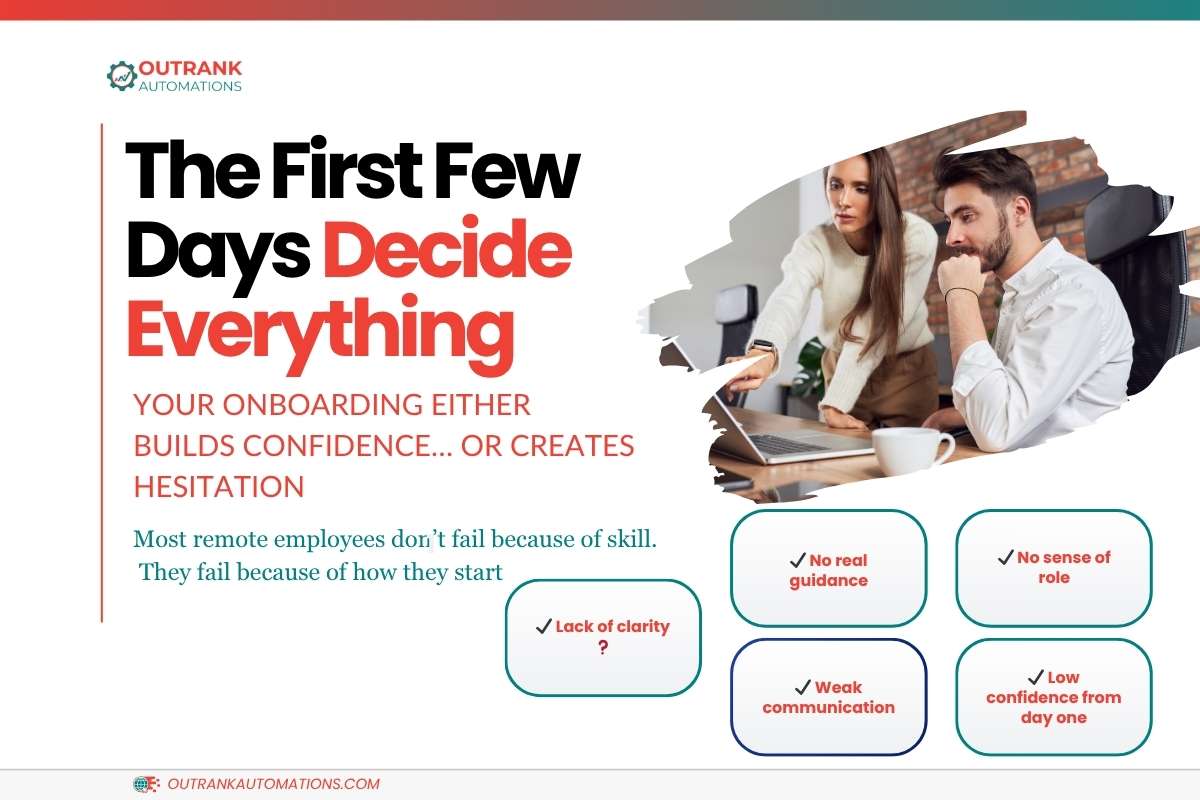
Why the First Few Days Can Make or Break a Remote Employee
A lot of companies treat onboarding like paperwork.
Log in here. Watch this video. Read this doc. Ask questions if you need anything.
And then they wonder why the new person still feels hesitant, reactive, and unsure two weeks later.
The first few days are not just about tasks. They are about identity.
Every new remote employee is silently asking questions like:
Do I fit here?
Can I do this?
Am I needed here?
Can I grow here?
Does anyone actually care if I succeed?
That is why the first few days matter so much. They do not just train skills. They shape confidence.
Scanner Highlights
Day one should create certainty, not just provide information.
New hires need your story, standards, and voice, not just your tools.
Strong onboarding creates culture before productivity.
Without clarity, even talented people hesitate — and hesitation is expensive.
Onboarding should give context, not just logins
If you want someone to show up like a real team member, you have to give them more than a login and a task list.
You have to give them context.
That means telling them your story. How did this company start? Why does the work matter? What do you value? What kind of client experience are you trying to create? What does success actually look like here?
These things may sound soft, but they are not fluff. They shape how a person interprets their role.
When someone understands the mission, they stop feeling like they are doing random tasks for random people. They start seeing how their work supports something bigger.
Clarity creates confidence
A new remote employee should understand:
what the company stands for
how you want clients to feel
who your ideal clients are
what your standards are
how their role supports the team
what good performance actually looks like
Without that clarity, even talented people hesitate.
And hesitation is expensive.
It slows communication. It creates over-asking. It makes people second-guess themselves. It keeps owners too involved in little things that should have been clear from the beginning.
Onboarding is also culture
This is something a lot of people miss.
Culture is not just built in team meetings, appreciation posts, or company values on a wall. Culture starts in the first few days.
If people feel welcomed, guided, supported, and clear, they begin to trust the company faster.
If they feel confused, invisible, or like they are expected to “just figure it out,” that becomes part of the culture too.
This applies to remote employees, but it also applies to your in-office admin team. People work better when they know where they fit, what matters, and how to succeed.
A better question to ask
Instead of asking, “Did we tell them everything?”
Ask, “Did we help them feel grounded?”
Because those are not the same thing.
The Bottom Line
The first few days can either create confidence or plant uncertainty.
And uncertainty has a way of showing up later as mistakes, low ownership, or someone quietly disconnecting from the role.
A strong start does not guarantee perfect performance. But a weak start almost always creates avoidable problems.
If you want this level of clarity to be consistent for every new cleaning tech, book a demo here.
We’ll walk you through the exact workflow: the messages, check-ins, and standards reinforcement that happen automatically after a new hire starts.
Hiring support: If you are hiring a VA soon, explore our VA hiring process here
Client retention: Learn about Lead & Client Nurture automations. We help you automate follow-up from lead to recurring client so fewer prospects slip through the cracks.
